
How Standardizing Materials Can Save Roofers Thousands Per Year
It’s Tuesday afternoon, and your crew’s halfway through a standing seam install. You’re thinking about watching the next Bobcats game with your buddies when your foreman calls down from the ridge:
“Hey — which vent are we using on this one?”
It shouldn’t be a hard question, but it is—because you’ve got three different ridge vent systems on the truck, and the answer depends on which supplier had stock last week.
He grabs the wrong one and doesn’t realize it until he’s already up there. Well, that’s 45 minutes of labor gone, a trip back to the shop, a frustrated crew, and a conversation you didn’t want to have.
Those shenanigans cost $200. No big deal, right? Except it happened last month, too. And the month before that, it was a callback because the new guy installed a system he’d never worked with. And the month before that, you threw away half a box of ridge vent that didn’t match anything on the schedule.
These costs add up quickly, and it’s hard to put a price on them because none of them appear on an invoice. There’s no line item for “confusion.” No receipt for “wasted trip.” But across a full year of jobs, that slow drip of waste, rework, and inefficiency can quietly drain thousands from your bottom line and your crew’s morale.
It’s exactly why we designed Snap-Z the way we did. By standardizing your materials—choosing a consistent set of products, in this case, standing seam ridge vents—and sticking with them, you have one of the simplest ways to tighten up your operation and keep more money in your pocket.
Let’s break down exactly how.


TL;DR – How Standardizing Materials Can Save Roofers Thousands Per Year
- Juggling multiple product lines creates hidden, non-invoiced costs from ordering mistakes, slow training for new products (training drag), excessive supplier management, and jobsite confusion that leads to costly rework.
- Standardizing materials significantly reduces material waste, which can otherwise account for 10% to 15% of total materials, and allows leftover materials to be used on the next job.
- Consistency leads to faster, more efficient installation due to crew muscle memory. Saving 20–30 minutes per job over 100 jobs can recover 30–50 hours of labor.+
- A streamlined inventory simplifies storage and organization, reducing deadstock, minimizing emergency supply runs, and making reordering easier and more predictable.
- Operational improvements from standardization, such as reduced waste and increased labor efficiency, can save 2–3% on combined costs, translating to $20,000 to $30,000 back in the pocket of a $1 million-a-year business.

How Standardization Reduces Waste Across Jobs
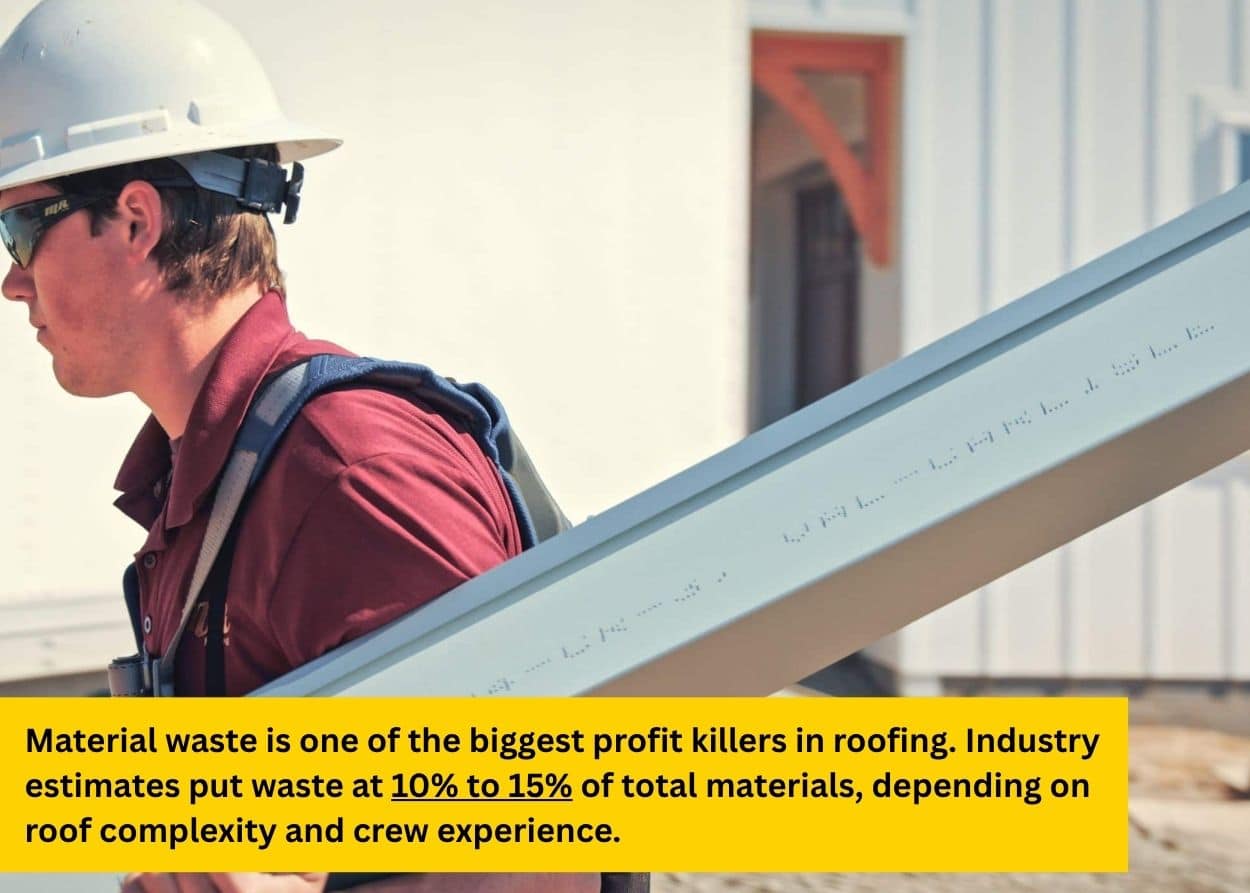
Material waste is one of the biggest profit killers in roofing. Industry estimates put waste at 10% to 15% of total materials, depending on roof complexity and crew experience. On a $15,000 materials order, 10% waste is $1,500 lost. If you multiply that across a full year of jobs, that’s a lot of money literally thrown into the dumpster.
Standardizing materials helps cut waste in two important ways:
- Your crew gets faster and more precise with familiar products: When your installer has put on the same ridge vent system 200 times, they know exactly how to cut it, fasten it, and finish it. There’s less scrap. Standardization isn’t new, but it’s a key element of an efficient, lean operation that many companies miss.
- Leftover materials can roll to the next job: If every job uses the same products, your extras aren’t orphans, and they’re not excess material costs for the client or contractor to absorb—they wind back in inventory, especially if it’s a standardized color. That half-box of ridge vent from Tuesday’s job goes right onto Thursday’s truck. But if Tuesday’s job used Brand A and Thursday’s uses Brand B? That half-box just sits there collecting dust.
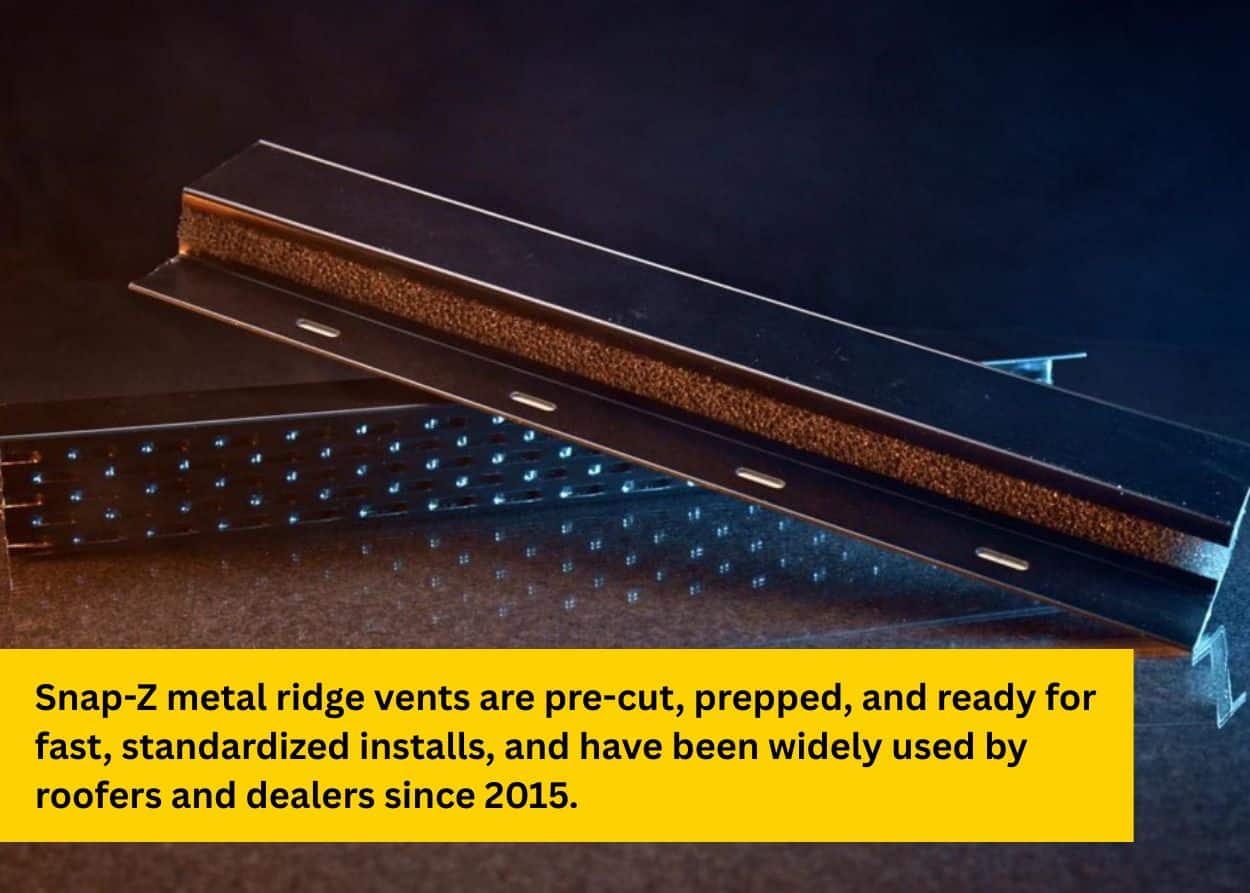
This is where products designed for standardized installs really shine. Take Snap-Z’s metal ridge vent system, for example. Our vents come pre-cut to your panel specs, with pre-applied butyl tape and pre-punched fasteners. There’s very little on-site cutting or customization needed, meaning very little waste. It’s the kind of product that’s built to be standardized across your jobs.
Faster Installation Through Consistency
You know that old saying: How do you get to Carnegie Hall? Practice!
So, how do you get more ridge vents done? Consistency! Speed matters on a roof—not reckless speed, but efficient speed, the kind where your crew knows the process cold and moves through it without stopping to read instructions or improvise a workaround.
When every job uses the same materials, your crew builds muscle memory, making the install second nature. No more figuring out “what screw spacing does this one need?” or “does this vent go foam-side down?” They just know.
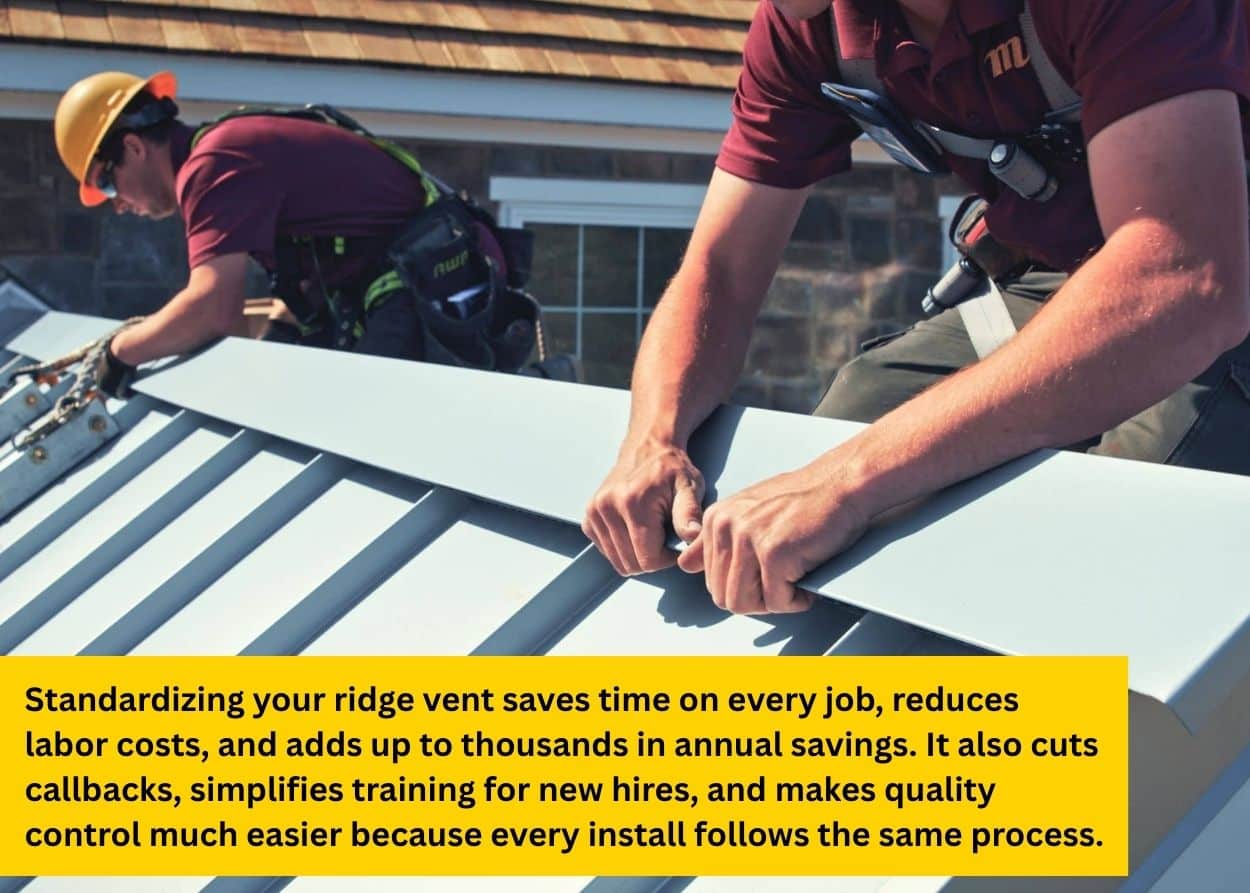
Standardizing your ridge vent saves your crew even 20–30 minutes per job—because there’s no on-site cutting, no guesswork, no figuring out a new system—that adds up fast. Over 100 jobs a year, you’re looking at 30–50 hours of labor recovered. At a $50–75/hour loaded labor cost, that’s $1,500 to $3,750 in annual savings on just one component.
And the savings don’t stop at the install itself:
- Fewer callbacks. Consistent installation equals consistent results. Your crew doesn’t make the rookie mistakes that come with unfamiliar products. Fewer callbacks mean fewer unpaid truck rolls and happier customers.
- Easier training. New hire? They need to learn one system, not five. That gets them productive faster and reduces the need for supervision.
- Better quality control. When every install follows the same process, it’s easier for you or your foreman to spot something that’s off.
Inventory and Storage Benefits
With small-to-mid-sized roofing operations, your shop space is valuable. Every square foot taken up by products you might use on a job is a square foot you can’t use for something else, and it's money flowing out the back door.
When you carry five different ridge vent systems, you need to stock all five. You need shelf space for all five. And you need to keep track of all five—which ones are running low, which have been sitting there since last summer, and which are the right size for next week’s job. It’s not just a hassle—it’s also a distracting inefficiency.
Standardize down to one or two? Everything gets simpler:
- Less deadstock. No more half-boxes of discontinued product gathering dust in the corner.
- Easier reordering. You know exactly what you need and when you need it. Some suppliers even offer better pricing when you commit to volume on fewer SKUs.
- Cleaner shop, cleaner truck. A streamlined inventory means a more organized operation. And an organized operation runs faster.
- Fewer emergency runs. When your crew knows what’s on the truck, they load correctly. No more mid-job supply store trips because someone grabbed the wrong box.
Think of standardization as inventory management on easy mode. You’re not eliminating complexity for the fun of it. You’re eliminating it because it saves time, space, and money.
Boosting Your Profit Margins—Without Working Harder
The average gross profit margin for roofing companies ranges from 20% to 40%, according to industry data from Roofing Contractor magazine. Net margins—what you actually keep after overhead, taxes, and everything else—typically land between 6% and 12%.
That’s a narrow margin, which means small operational improvements can have an outsized impact on your bottom line.
Let’s put it in perspective: Say you run a $1 million-a-year roofing business. If material standardization saves you just 2–3% in combined waste, labor efficiency, and inventory costs, that’s $20,000 to $30,000 back in your pocket—without adding a single new job.
And most of these savings happen automatically once you set the system up:
- Less waste = lower material costs per job
- Faster installs = more jobs per week (or earlier finishes, which crews love)
- Fewer callbacks = less unpaid labor and better customer retention
- Simpler inventory = lower carrying costs and fewer emergency purchases
- Supplier leverage = better pricing when you buy more of fewer products
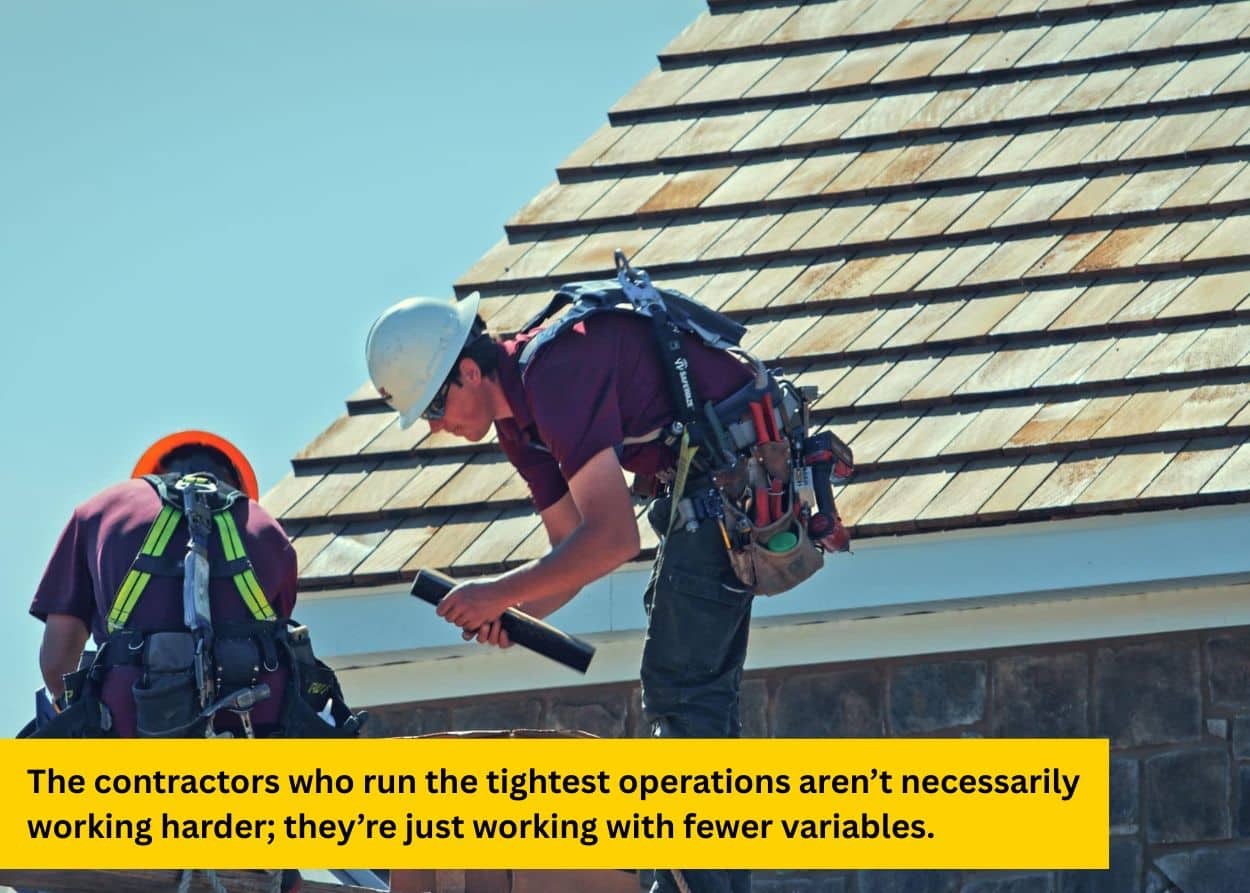
It’s not about cutting corners—it’s about cutting clutter. The contractors who run the tightest operations aren’t necessarily working harder; they’re just working with fewer variables.
What Standardized Materials Actually Look Like in Practice
Standardization sounds great in theory, but what does it actually look like on a Monday morning? It looks like this:
- Picking products that are designed for consistency. Not every product lends itself to standardization, but the best ones are designed to be pre-cut, pre-assembled, or spec’d to work across a range of common applications without field modification.
- Working with suppliers who support your system. A good supplier doesn’t just sell you materials; they help you plan, reorder efficiently, and keep lead times predictable.
- Training your crew once, then reinforcing what they learned. When the whole team installs the same products the same way every time, your foreman spends less time supervising and more time managing the job.
- Documenting your standard loadout. Create a go-to materials list for your most common roof types. If 80% of your jobs are standing seam metal roofs, your loadout should be dialed in for that work.
It’s exactly the approach Snap-Z was designed to support. Our patented ridge vent system ships pre-cut to your exact panel width (down to 1/16”), with butyl tape already applied and fastener holes pre-punched. Your crew shows up, and the product is ready to install. There’s no need for field fabrication or guesswork: all you need is a screw gun and screws.
That’s what standardized materials look like in action. It fits your process—not the other way around.
The Bottom Line
Roofing is hard enough without making it complicated. Every extra product variation you carry is a small tax on your business—in waste, in training, in storage, in mistakes, and in the mental energy it takes to keep everything straight.
Standardizing your materials won’t fix every problem, but it will quietly solve a dozen small ones that are eating into your margins every single week.
The result is less waste, faster installs, fewer callbacks, simpler inventory, better pricing, and a crew that works with confidence because they know exactly what they’re doing. That’s the kind of advantage that compounds over time.
Snap-Z’s metal ridge vents are built for standardized installs—pre-cut to your panel specs, with pre-applied butyl tape and pre-punched fasteners, and trusted by thousands of roofers and dealers since 2015.
Contact us today to see how our ridge vent system can tighten up your operation and put more money back in your business.